Pocket pens
Shorter pens designed to travel. Lovely for a bag or coat pocket, and often comfortable once posted—when the cap is placed on the back of the pen.
The Writing Room guides · 01
A simple, friendly place to begin—whether you want to write, draw, make art, or are simply curious about trying something different.
Start here
A fountain pen is not a test you have to pass. There is no secret handshake, no need to learn everything at once, and no right sort of person for it.
The best first pen is simply one that makes you want to put something on paper. That might be a quick list, a letter to a friend, a page in a journal, a sketch, or the beginning of a new habit.
Good writing tools should feel welcoming, not intimidating.
Our gentle advice
Your first pen should be inexpensive enough that, if it does not suit you, you have not made an expensive mistake. You may love it for notes, letters, journalling, sketches, art—or simply the pleasure of writing slowly.
You may decide it is not for you. That is fine too. The point is not to become a fountain-pen person; it is to give yourself a pleasant, low-pressure way to find out.
Choose a first pen you would be happy to keep using, but comfortable enough to put down if it is not quite your thing.
The pen itself
Shorter pens designed to travel. Lovely for a bag or coat pocket, and often comfortable once posted—when the cap is placed on the back of the pen.
The familiar middle ground: easy to hold, easy to carry, and a very good place to start for most hands and most writing.
A little more presence and often a more relaxed grip. They can suit longer writing sessions, but bigger is never automatically better.
Look for a pen that feels steady in your hand. If you want expressive lines, a nib with a little flex can widen with gentle pressure—but a firm nib is often easier to control when you are beginning.
Nib sizes
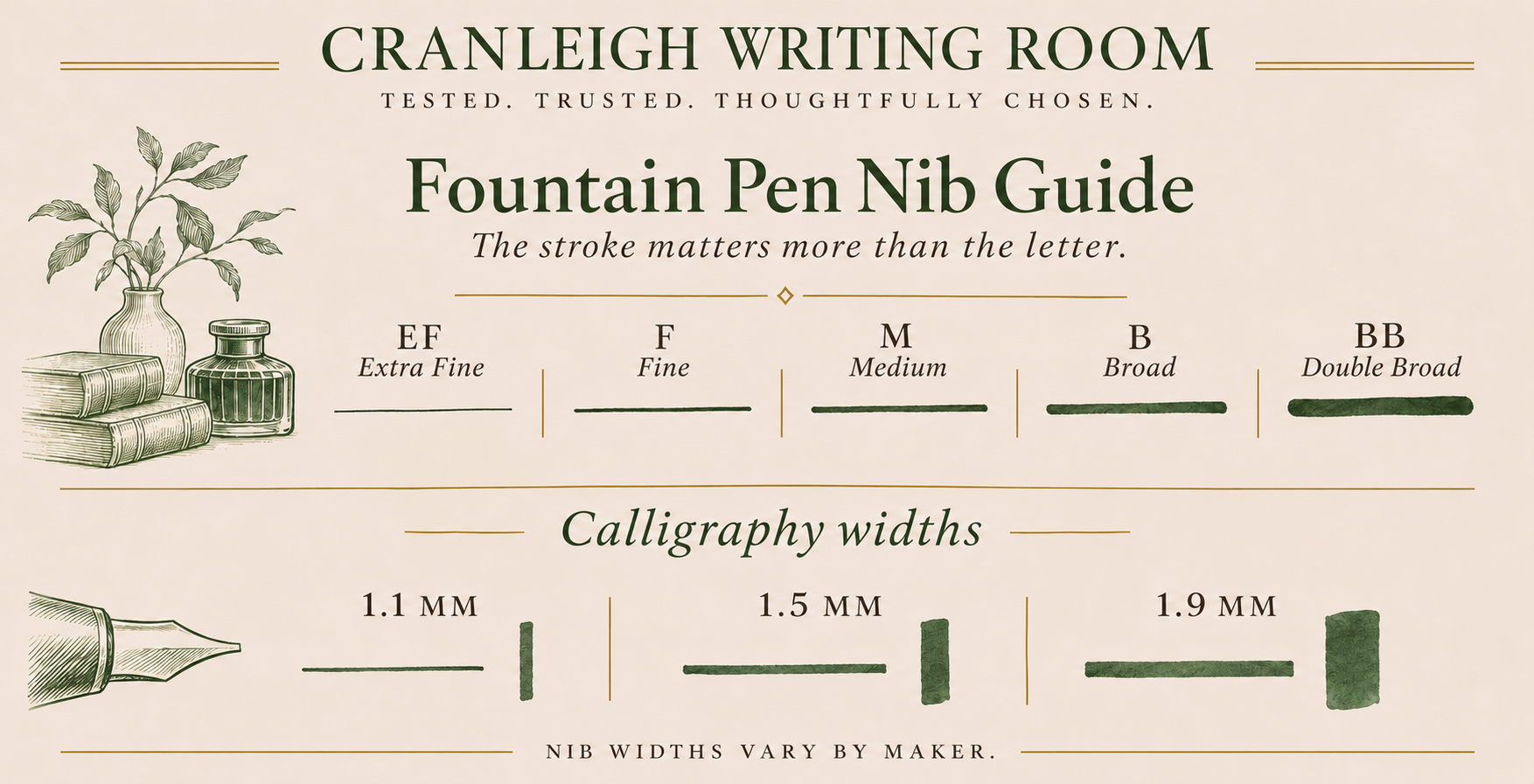
The nib is the small metal point that touches the paper. Its width changes the character of your line—and a visual comparison is much more useful than the letter alone.
Pen terms, made simple
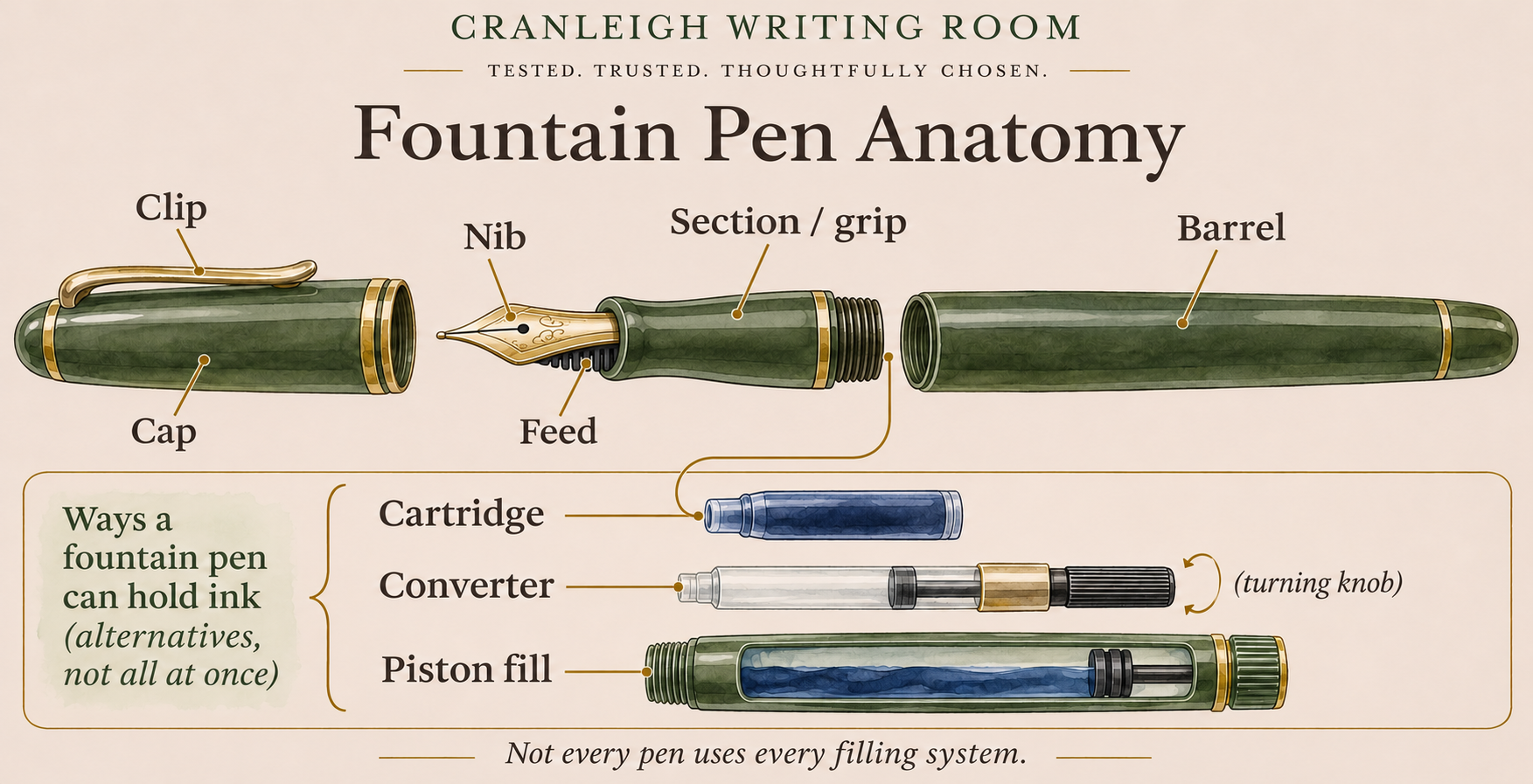
These are the names you will see again and again when choosing, filling and caring for a fountain pen. The three filling systems below are alternatives: a pen uses one of them, not all three at once.
Cartridges & ink
Remove the barrel from the section—the part that holds the nib and grip.
Push the narrow end of a compatible cartridge firmly onto the fitting behind the nib. You will usually feel it pierce and settle into place.
Screw the pen back together, then give the ink a moment to travel to the nib before writing.
A converter replaces a cartridge and lets you use bottled ink. Fit it into the pen in the same way as a cartridge, immerse the nib in ink, then turn the knob to draw ink in. To help the ink flow properly, gently twist to draw ink in and twist back to expel it, then repeat that full in-and-out cycle once more. On the second draw, leave the converter full. It is reusable, so you can enjoy more colours without throwing anything away.
A piston-fill pen has its ink reservoir built in. Immerse the nib in bottled ink, then turn the end knob to draw ink up into the body. Gently draw ink in, turn the knob back to expel it, then repeat that full in-and-out cycle once more. On the second draw, keep the ink in the pen. It usually holds more ink than a cartridge, and it is wonderfully simple once you have done it once.
A quiet but important note: use cartridges made for that pen, or ones confirmed as compatible. With converters and piston-fill pens, rinse with cool water between ink colours and before storing a pen for a long time.
Do not forget paper
Fountain pen ink can behave differently on different paper. Smooth, fountain-pen-friendly paper lets the nib glide and keeps the line clean; very absorbent paper can make ink spread or show through.
You do not need a specialist notebook to begin. But when you are ready, the right paper is one of the simplest ways to make a good pen feel even better.
The right one for you
There is, however, a pen that can be perfect for you: one that suits your hand, your budget, what you want to create, and the way you like to write or draw.
We will help you find it—plainly, patiently, and without making you spend more than you need to.